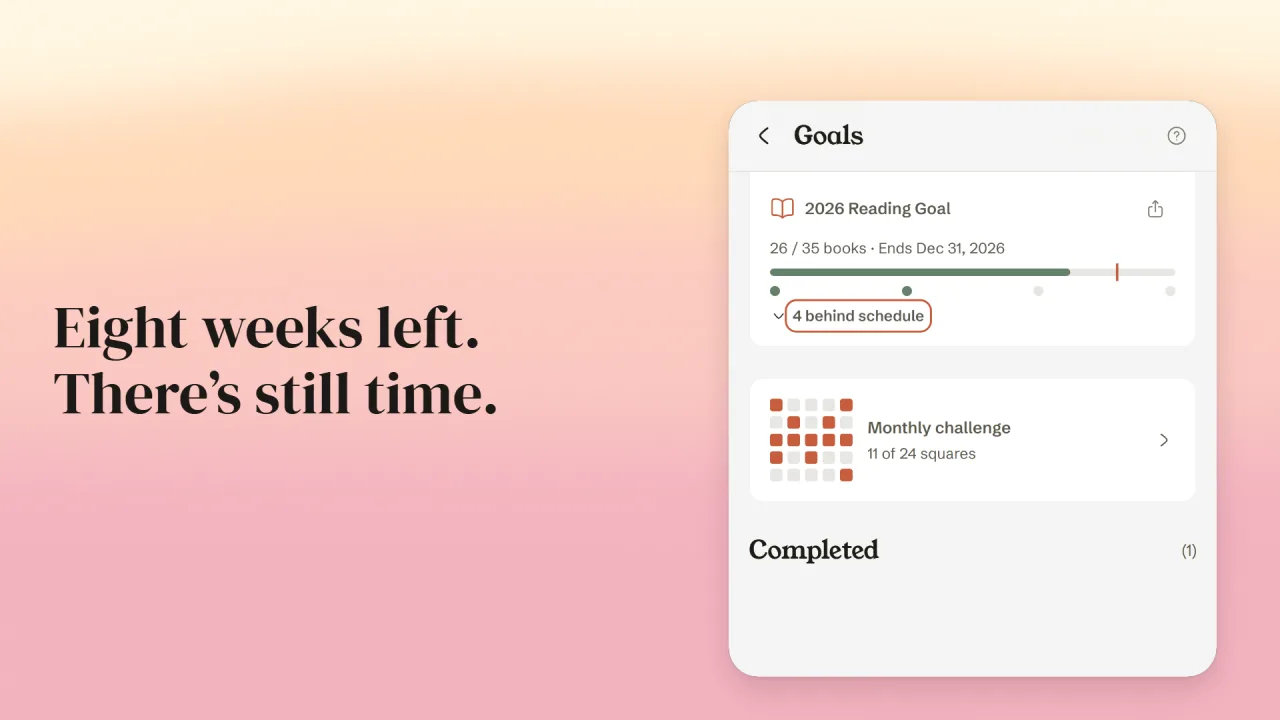
Sometime in January, you wrote a number down. Maybe it was 30. Maybe it was 52, and you felt a little brave about it.
That number made sense to January you, who had fresh energy and a clean shelf. November you has seen how the year went. The number has been quietly judging you from the corner of your phone ever since.
I'm behind on mine too. I set 50 books in January and I'm at 28. To catch up, I'd need to read four times faster than I have all year. That's not a plan, so I'm writing a real one down for both of us.
It covers the last eight weeks, without speed-reading or guilt. Take what fits your life and ignore the rest.
If you only have a minute, here is the whole thing:
- Find out the real gap. A gap you can measure is easier to face than one you can only feel.
- Do the math once, then stop thinking about it.
- Pick shorter books. A short book finished counts the same as a long one.
- Borrow time from the dishes and the dog walk, and read at the hour you read best.
Start by looking at the real number
Dread loves a vague number, so let's make yours specific.
Open your goal. Under the progress bar there is one short line, either "On track" or something like "4 behind schedule". It compares what you've finished with where you'd be at an even pace since 1 January.
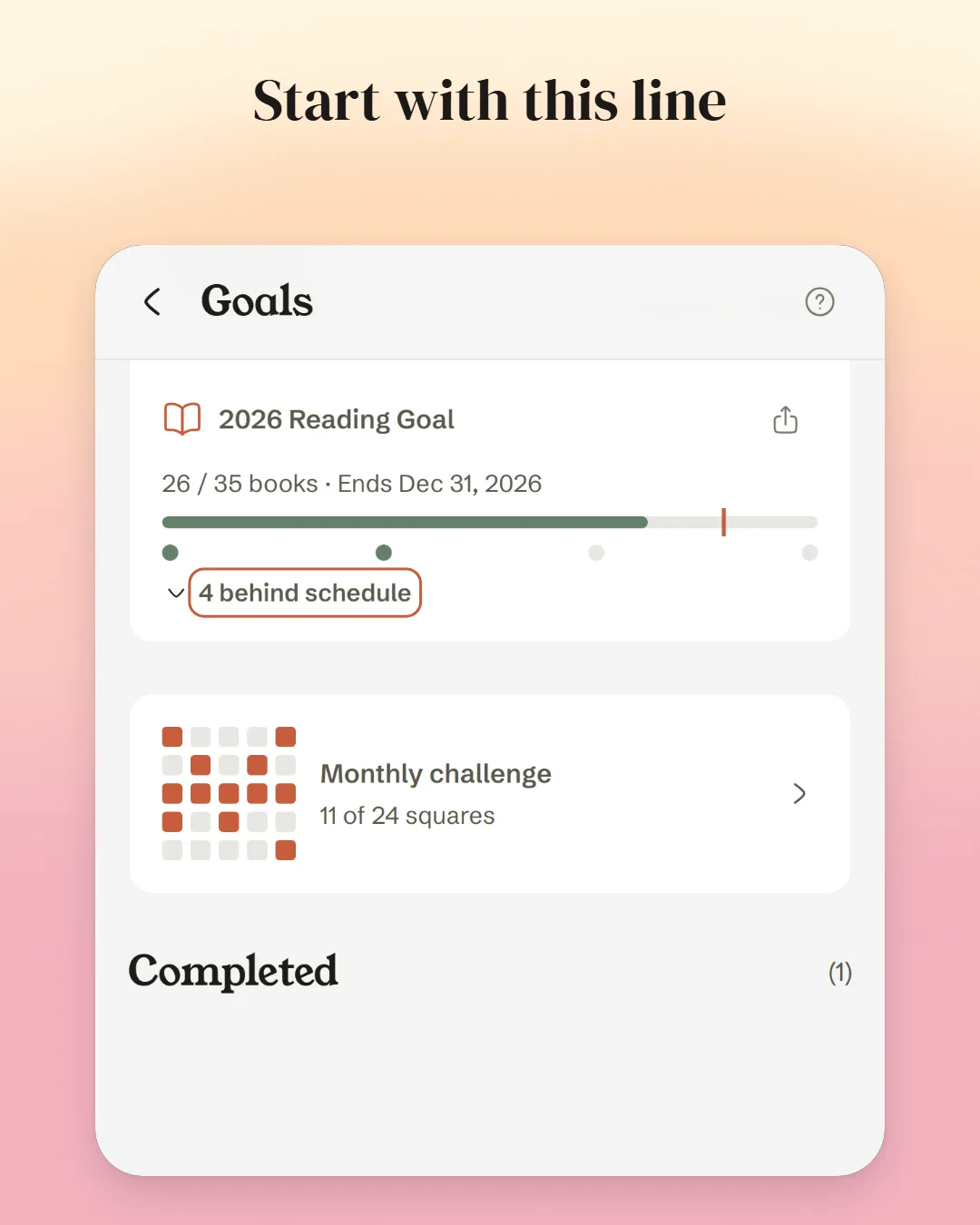
Four books is a gap you can plan around. It says nothing about the kind of reader you are.
Tap the goal and you'll see a projected finish date too. That is where you land if the next two months look like the last ten. For someone at 26 books out of 35, it's late February, a few weeks after the year ends. That is the date you're trying to beat.
Do the math once, then stop thinking about it
Say your goal is 35 books and you've finished 26. That leaves nine.
Count the days until 31 December. In early November that's about 55, a little under eight weeks. Nine books in eight weeks is a bit over one a week, or a book every six days.
Now the uncomfortable half. Divide the days of the year so far by the books you've finished. Day 310 and 26 books means a book every twelve days or so. To make the goal, you'd have to read twice as fast.
This is where most of us quietly close the app. Please don't. Twice as fast is a bad plan, so skip it and read lighter books instead.
Here's what that target asks of you, depending on how many books are left and how long they are. The table spreads each count over 56 days.
| Books left | Time for each book | At 200 pages each | At 400 pages each |
|---|---|---|---|
| 3 | About 19 days | 11 pages a day | 21 pages a day |
| 5 | About 11 days | 18 pages a day | 36 pages a day |
| 9 | About 6 days | 32 pages a day | 64 pages a day |
| 12 | About 5 days | 43 pages a day | 86 pages a day |
Look at the nine-book row. Long books ask for 64 pages a day, short ones for 32. It's the same you in both rows. Only the pile changed.
If you'd like your real pace rather than my estimate, the Stats page has it. Books per month is free and shows which months carried you. Pro adds the average days you take per book, plus pages per hour for the book in your hands.
And if 35 felt ambitious from the start, here's what a typical year of reading looks like. You may be doing better than you think.
Give yourself permission to read short
Here is the unofficial rule of the last eight weeks: nobody is checking your page counts.
A goal counts the books you finish. It doesn't care how thick they were, unless you narrowed it by length, genre or format. That 700-page fantasy you started in September can wait on the nightstand until January. It's parking, and parking is allowed.
Meanwhile, novellas count. So do short story collections, poetry, graphic novels and manga volumes. Some of the books people love most run 150 pages, and you can finish one in an evening.
If you have a comfort author, now is their moment. Mine are Terry Pratchett and P. G. Wodehouse, 23 and 14 books so far, which tells you something. I also have four books open at once, one of them a manga, so I'm no model of focus.
A decent plan for nine books: keep one big book you love, and fill the rest with quick reads.
Let a filter do the choosing
Choosing is where eight weeks go to die, so hand it to a filter. In Browse, open the filters and find Length. Drag the range, or tap a preset like "Up to 200 pages". The button at the bottom tells you how many books fit.
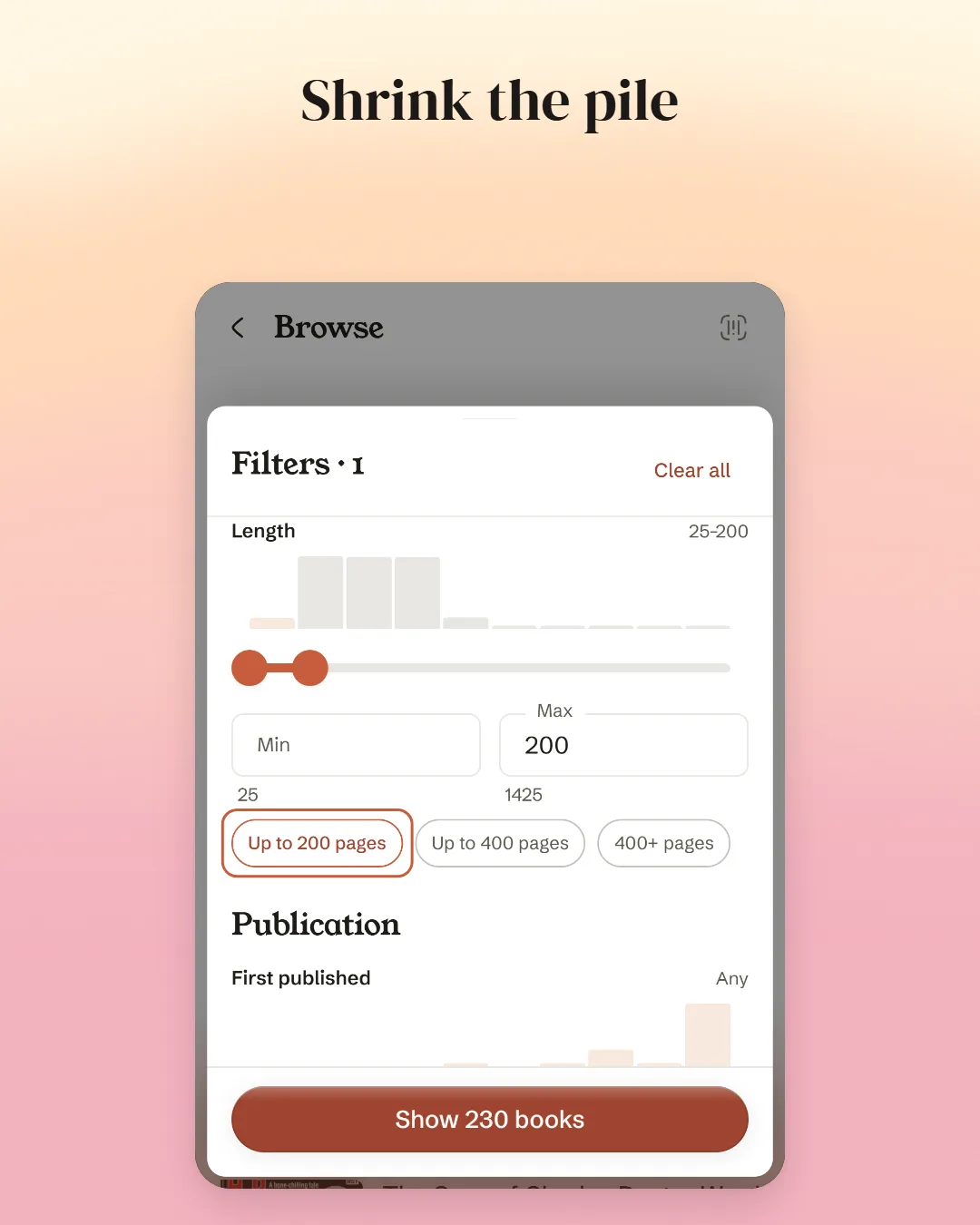
Every result shows its page count, so you know what you're signing up for. Tap Want to read when something looks good.
Then raid your own pile
You already own more books than you've read. We all do. The same length filter works on your library. Pick Want to read, set a range, and the shelf shrinks to books you can finish soon.
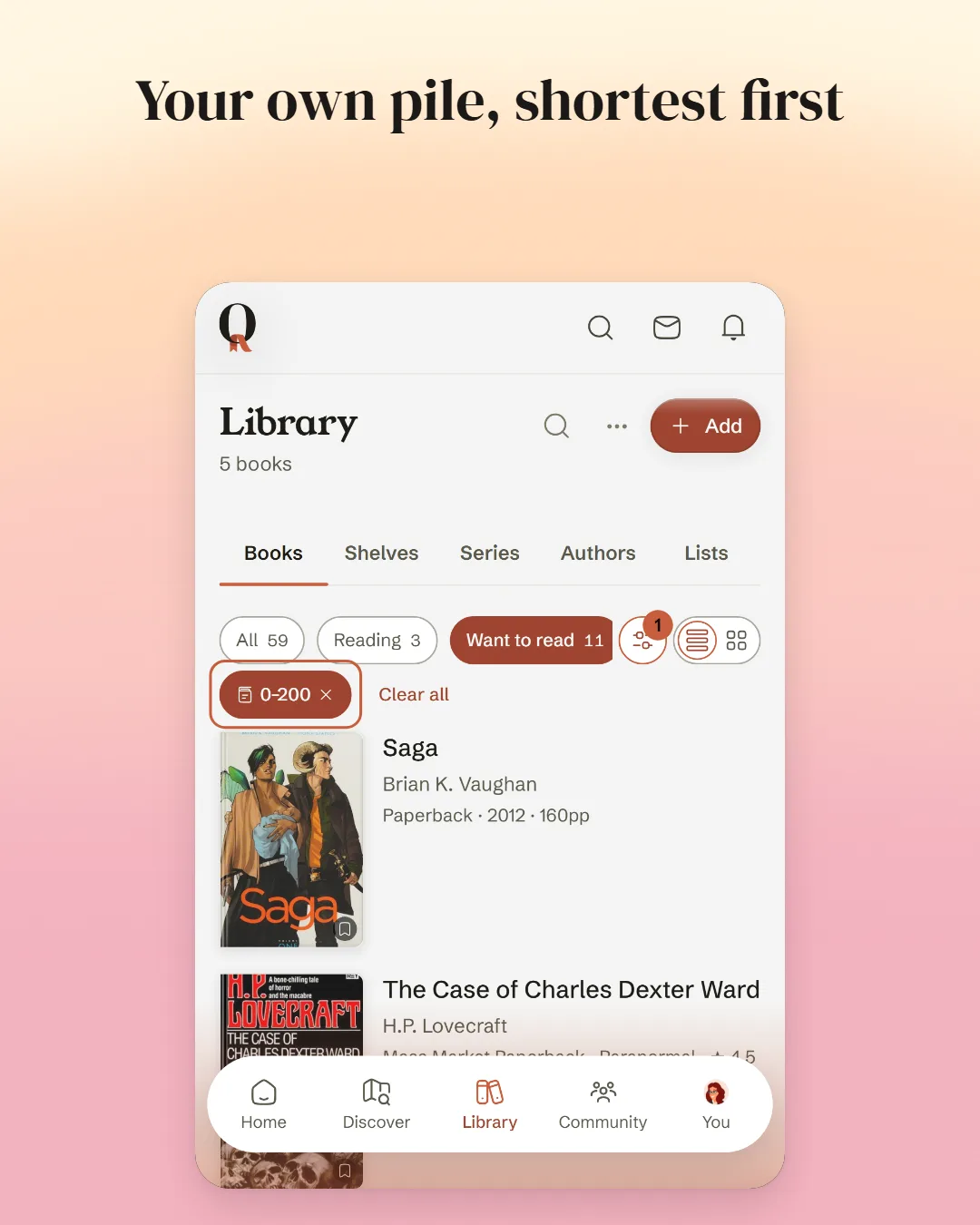
Browse also has a Kind of book filter for novellas, short stories, graphic novels, poetry and manga. And if you can't choose at all, Pick something for me draws from your Want to read shelf. Let it. Deciding is the heaviest part.
If you'd rather choose by feeling, here's a guide to finding your next book by mood, trope and taste. A shelf that fills itself with short books helps too, and there are 26 shelf rules to borrow. If one book on your list is dragging you down, you're allowed to drop it. Here's how to quit without the guilt.
Borrow hours you already have
You probably can't find more reading time. But your hands are busy for hours every week. Dishes, laundry, dinner, the commute, a walk to nowhere in particular.
Those are listening hours. A 30-minute walk five days a week adds up to two and a half hours. Over eight weeks, that's twenty hours of book. Twenty minutes of dishes a day adds more than two hours a week on top. The dishes finally have a purpose.
Nobody gets to call that cheating. Audiobooks count as reading, and if you need the receipts, there's a whole post on that. When you finish one, it counts as a book on your yearly goal. The one catch: if you limited your goal to a single format, like print, an audiobook won't move it.
To track one, switch the book to its audiobook edition and log where you are by time or percentage. Here's the step-by-step. There's also a Listening goal, which counts minutes instead of books. It rewards the walking itself. And if you need something for a long drive, here are thirteen audiobooks for road trips.
Find the hour that works for you
Most readers have one slot where reading just happens. For some it's the quiet at 6 a.m. For others it's eleven at night. You promise yourself one chapter and wake up at one with the lamp still on.
Pro has a card for finding yours. It's called When you read. It splits your reading into morning, afternoon, evening and night, then tells you which one wins. You add it from Stats: tap Customize and switch it on.
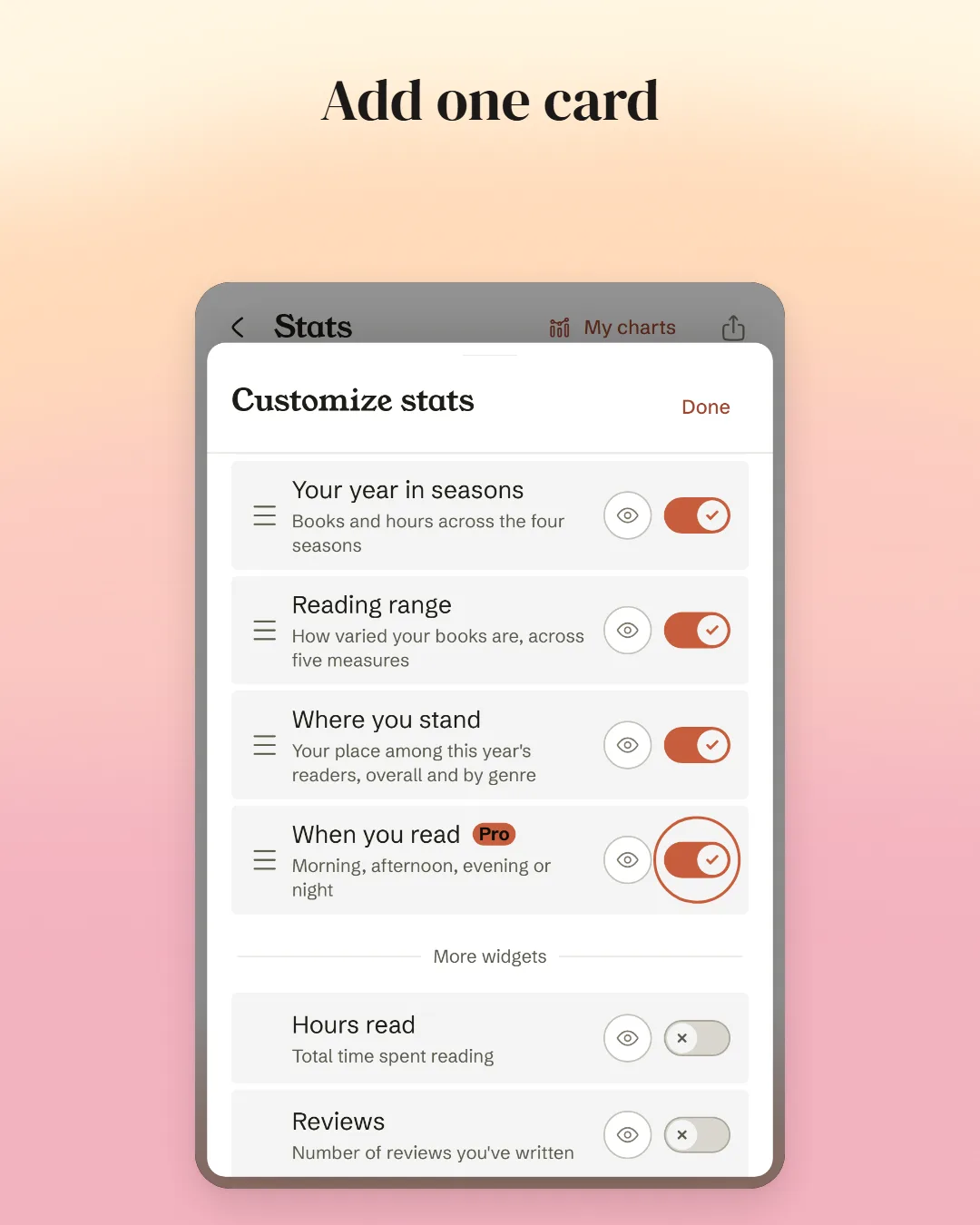
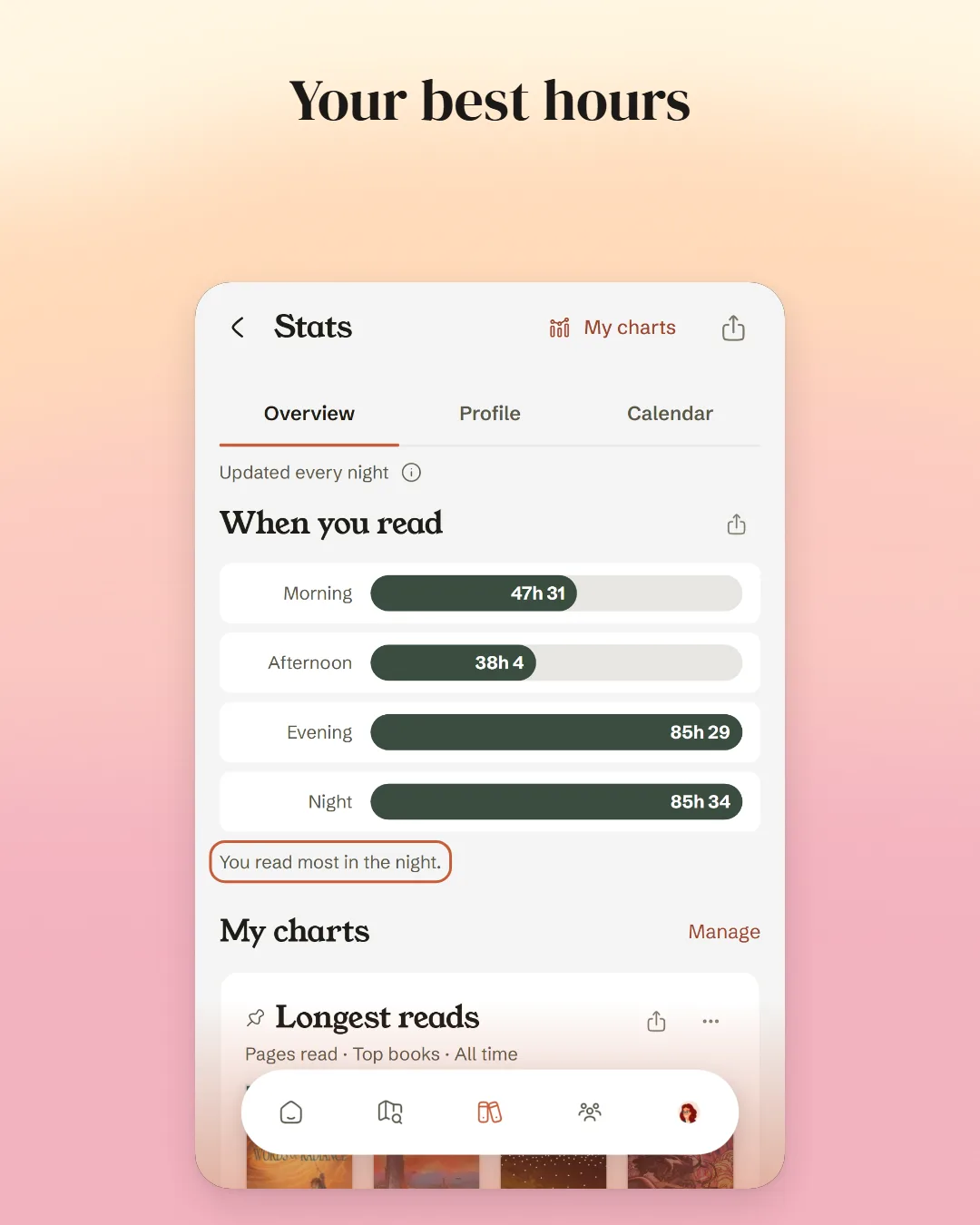
It only counts reading that came with a time. That means the reading timer, reading inside the app, or a paired e-reader. A page count typed in by hand has no hour. So use the timer for a week if you want a clear picture. If you read on a Kindle or Kobo with KOReader, syncing it sends the time for you.
No Pro? Do it by hand. For a week, write down when you actually read, not when you meant to. Then protect that hour like an appointment. A daily reminder at that time helps. So does a daily goal in minutes, pages or chapters.
Start the timer when you sit down, too. Watching the minutes add up feels better than checking the pace line.
If the habit itself has gone missing, these two are for you: why you stopped reading in August, and three fixes, and how to read more when life feels overwhelming.
Don't do it alone
Goals are easier when someone is waiting for you to turn up. A buddy read gives you one book and a friend to keep pace with. A book club gives you a deadline someone else set, which is oddly useful when yours has stopped working. A shared goal in Community puts you and a few readers on the same number, with everyone's progress in view.
Joining any of them is free. Starting your own has a limit on the free plan.
If the number is simply wrong
Sometimes you do the math and it still doesn't fit. A new baby, a hard autumn, a job that ate your evenings. That's life getting in the way. Nobody should grade you for it.
I'm already eyeing this section for my own 50.
A yearly target can't be edited once you've set it, so here's the workaround. Open the goal, tap Abandon goal, then add a new one with the plus button. Choose Books, This year, and a number that suits the weeks you have left.
A goal is a tool for reading more. If this one has started to feel like homework, swap it for one that works.
Your first week
- Tonight: open your goal and do the math. Write down the books left and the weeks left.
- Tomorrow: filter your Want to read shelf by length and pick your next three books. Keep one longer book if you're enjoying it.
- This weekend: choose one slot, whether a walk, the dishes or the late evening, and set a reminder. If you want to listen, switch one of the three to its audiobook.
- Next Sunday: look at the pace line again. If it hasn't moved, change the plan before you change yourself.
I'm 22 books short of 50, with a manga in progress. Let's go finish something.
And if you're curious why tracking helps in the first place, here's the longer answer.