Ernest Hemingway
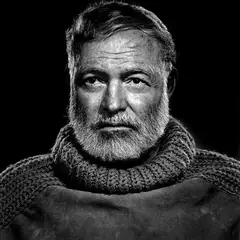
Ernest Hemingway
Author • Editor21 July 1899 – 2 July 1961 · From United States- Books
- 40
- Followers
- 0
About
Ernest Miller Hemingway (21 July 1899 – 2 July 1961) was an American novelist, short-story writer and journalist whose spare, understated prose reshaped twentieth-century fiction. Born in Oak Park, Illinois, he worked briefly as a reporter before serving as an American Red Cross ambulance driver on the Italian front in the First World War, where he was seriously wounded by mortar fire in July 1918 and decorated for helping other wounded men to safety.
He settled in Paris in the early 1920s as a foreign correspondent for the Toronto Star, joining the expatriate circle around Gertrude Stein, Ezra Pound and James Joyce that Stein called the "Lost Generation". The Sun Also Rises (1926) made his name and A Farewell to Arms (1929) established him as a major American writer.
He wrote on bullfighting in Death in the Afternoon (1932) and safari in Green Hills of Africa (1935), settled in Key West and later at Finca Vigia outside Havana, covered the Spanish Civil War from 1937 and drew on it for For Whom the Bell Tolls (1940).
He reported the Normandy landings, the liberation of Paris and the Battle of the Bulge for Collier's.
The Old Man and the Sea (1952) won the Pulitzer Prize for Fiction in 1953, and he received the Nobel Prize in Literature in 1954. Injuries from two plane crashes in Africa that year left him in lasting pain, and he died by suicide at his home in Ketchum, Idaho, in 1961. Several books, among them A Moveable Feast and Islands in the Stream, appeared posthumously.
Top genres
Classics Literary Fiction Fiction Short Stories Essays
Also known as
Links
Featured works



Series


Authors in the same genres


Frequently asked questions
Ernest Hemingway is widely recognized for his distinctive minimalist prose style, often referred to as the "iceberg theory," where much of the story's meaning is implied rather than explicitly stated. He was awarded the Nobel Prize in Literature.
Many of Hemingway's works have been adapted for the screen, including "The Old Man and the Sea," "A Farewell to Arms," "For Whom the Bell Tolls," and "The Sun Also Rises."
For readers new to Hemingway, "The Old Man and the Sea" is often recommended as an accessible entry point due to its concise nature and clear narrative. Alternatively, "The Sun Also Rises" provides a strong introduction to his themes and style within a novel format.
Yes. Hemingway received the Nobel Prize in Literature in 1954, cited by the Swedish Academy "for his mastery of the art of narrative, most recently demonstrated in The Old Man and the Sea, and for the influence that he has exerted on contemporary style". Still in poor health after two plane crashes in Africa earlier that year, he did not travel to Stockholm, and the United States Ambassador to Sweden accepted the prize on his behalf. The year before, The Old Man and the Sea had won the 1953 Pulitzer Prize for Fiction.