Steven EriksonFiction · Fantasy·b. 1959
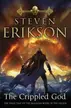
The Crippled God
Synopsis
The conclusion of the ten-book Malazan Book of the Fallen. The Bonehunters are surrounded, outnumbered, and dying — yet they march. What they march toward is the Crippled God, a shattered alien deity chained to the world against his will, whose suffering has been the hidden engine of the entire series.
The Crippled God delivers on every thread Erikson has laid across nine preceding volumes: the death of soldiers whose names we know by heart, the resolution of divine wars older than human civilization, and a final argument about compassion that is the most explicit statement of the series' moral purpose.
It is a novel about the value of bearing witness, the cost of holding the line when no one else will, and what it means that a group of mortal soldiers chose to walk into the dark for someone they had never met.
Collected in
How it reads
- Writing5.0
- Impact5.0
- Characters5.0
- Plot5.0
- Atmosphere5.0
Prose complexity 7/10
Content warnings (4)
ViolenceGraphic ViolenceTraumaAbuse
Readers say (1)Fast · Literary · Tense · Dark · Thought-Provoking
Readers flagged (4)
ViolenceGraphic ViolenceTraumaGore
- I came into the first book of this series, Gardens of the Moon, not knowing what to expect. It threw me into a world so deep and rich. Erikson doesn't hold your hands. You see things unfold through the characters' eyes. I was lost. I was also hooked. That first year I read the first 5 books. Each one pushed the limits of what I thought was possible in the genre. Characters I loved died. Some died badly, some died well. A few deaths I'm still not over. The world kept expanding in ways that felt earned. There was no padding events just to fill up the pages. It was like Erikson had built the entire thing before writing a single page. Then two years later I read 4 more then stopped. Not because I fell out of love with it. Because I'd fallen so deep that finishing felt like a kind of loss. I kept the last book there, in my TBR, unread, for years. This year I had to know how it ended. The Crippled God broke me. Not the way bleak fiction breaks you. The opposite. After ten books of war, grief, and cosmic scale, the answer this series builds to is simply compassion. That's it. The most powerful force in this universe? The decision to extend your hand to a suffering thing. Characters I'd carried through hundreds of pages died here. Most knowing they would. Most choosing to anyway. My eyes filled up more than once. What struck me most was the scale inversion. Epic fantasy usually uses intimacy to ground grand events. Erikson does the reverse. The grand events exist to ground the intimacy. Magical realms (Warrens) collide, armies march, gods break. All of it builds to one person choosing another over themselves. Bittersweet is the right word. Every resolution cost something. Nothing was free. And yet it didn't feel cruel. It felt true. I don't think anything in this genre has moved me more. I don't think anything ever will.
- A six-year reading journey concluded with a truly epic finale, worthy of the entire decalogue. Erickson not only managed to tie together in a perfectly logical way all the threads of the complex story he had woven (short of a Fallen God who fell on a planet where almost everyone had been exploiting him for millennia, except for a few gods, humans and other creatures who set out to save him) but at the same time avoided the conveniences of the genre, managing to highlight compassion and empathy as the core values of the story, extending them even to those who initially appeared as villains; with only one proviso: that they understood that the world is constantly changing. Those who remained stuck in their obsessions are those who were deprived of any redemption. A profoundly philosophical and political work, with unparalleled prose, stirring descriptions, raw realism alternating with unexpectedly lyrical moments, poignant moments, and rare humour, it is grossly misjudged when it is classified simply as fantasy.