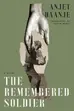


Longlisted for the International Booker Prize 2026. National Book Award Finalist. Republic of Consciousness Prize Winner.
There is a man in a Belgian asylum. He does not know his name. He does not know where he came from or who he was before the war pulled him under. The nurses call him Noon Merckem because he was found wandering near Merckem at noon in 1917, likely a survivor of Passchendaele, shell-shocked, emptied of himself. Women come to see him regularly. They respond to a newspaper advertisement hoping he is their missing husband. He is not their missing husband. Then one day a woman named Julienne arrives, and she says he is.
That is the premise of The Remembered Soldier and it is one of the finest premises I have encountered in recent fiction. Anjet Daanje takes it and stretches it across 560 pages of post-WWI Flanders without once letting the tension go slack.
The Question the Novel Refuses to Answer
Julienne claims the man is Amand Coppens, her husband, a photographer, father of two children, a man who walked into the war and did not walk out the same. She takes him home against medical advice. He settles into a life he cannot verify. He learns the names of his supposed children. He lies beside a woman he may or may not have loved before the war took his memory. He begins to wonder whether she is telling him the truth about who he was. And crucially, so does the reader.
Daanje keeps this central uncertainty alive for the entire novel without it feeling like a trick or a game. She is not interested in whether Julienne is lying for its own sake. She is interested in what it means to build a life on a story you cannot confirm, in how much of identity is simply the account others give of you, in how trust between two people is constructed out of exactly the same fragile material as memory, chosen, partial, subject to revision.
The Photography Studio
One of the most haunting details in the book is what Julienne does for money. She photographs Amand in military uniform, posing as the dead husbands of war widows who want something to hold onto. The negatives she works over, adjusting, removing evidence of absence, constructing a version of the past that can be borne. Daanje places this detail so precisely in the novel’s thematic architecture that you feel the weight of it long before you fully understand what it is doing. Here is a woman who alters images for a living. Here is a woman whose husband cannot verify anything she has told him about his own past. The parallel is not stated. It does not need to be.
How the Prose Carries the Reader
Daanje writes in long, stacked sentences that accumulate detail the way memory actually does, not in clean chronological order but in layers, one thing pressing against another. The style could easily become exhausting at 560 pages and sometimes it tests your patience. But it also produces moments of real astonishment, places where a sentence opens up in an unexpected direction and you feel the interior life of Amand or Julienne with an intimacy that shorter, neater prose could not have created.
David McKay’s translation preserves the rhythm of these sentences in a way that feels organic rather than carried over. The English text has its own momentum. It does not feel like a translation being faithful to its source. It feels like a novel written to be read in English, which is the highest thing you can say about translated prose.
The World Around the Two of Them
Daanje does not lose Flanders in the process of focusing on her characters. The landscape of post-war Belgium is present throughout, exhausted farmland, blighted fields, the particular social texture of communities where almost every family is missing someone. The poverty is not backdrop. It presses into every decision Julienne and Amand make, every moment of potential happiness undercut by the material reality of how close to the edge they are living.
The asylum sequences in the early chapters are among the best in the book. The other soldiers there, the men who returned from the war in various states of damage, are drawn with a specificity that makes them feel fully present rather than representative. Daanje resists using them as atmosphere. They are people.
Where I Found Friction
The novel’s scope, which is its great strength, is also where it occasionally loses me. At 560 pages, there are stretches where the slow accumulation of domestic detail, the gradual reacquaintance of husband and wife, moves at a pace that tests commitment. I understood the purpose of that pace. Daanje wants you to feel the effort it takes to rebuild trust between two people across that particular chasm. But there are sections in the middle third where the forward movement stalls in a way that felt less like deliberate suspension and more like the novel breathing too slowly for too long.
The children are also slightly underwritten. They are present throughout but never quite come into focus as distinct people, which matters because they are part of what Amand is being asked to accept as his past.
What Stays
The Remembered Soldier is, underneath everything else, a novel about what love requires of people. Not romantic love in any idealised sense but the daily practice of choosing to believe in another person despite the complete impossibility of certainty. Julienne cannot prove she is telling the truth. Amand cannot prove she is not. They have to decide, separately and together, how much they are willing to extend to each other across that gap.
That is not a WWI story. That is every story about every relationship that has ever survived something it should not have survived. Daanje has found it inside a historical case study and she handles it with the precision and the generosity it deserves.
Rating: ★★★★½ 4.5 / 5 stars
For readers drawn to: A Farewell to Arms by Ernest Hemingway, Suite Française by Irène Némirovsky, Beneath a Scarlet Sky by Mark Sullivan, anyone who has ever wondered how much of who we are is simply the story the people who love us keep telling about us.

