
★★★★★ 5 / 5 stars
There are books you read once and remember. There are books you read twice and understand differently. And then there are books like Fahrenheit 451 that you return to across the years and find, each time, that the book has not changed at all but you have, and the distance between those two facts is where all the meaning lives. I have come back to this one more times than I can count. It has never once felt like the same book twice.
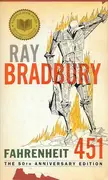
Guy Montag is a fireman. In this world, firemen do not put out fires. They start them. Books are illegal. Houses are fireproof. When someone is found to own books, Montag and his crew arrive with kerosene and flame and burn the books along with the house, sometimes along with the person who refused to leave them behind. Montag does this work without questioning it, for years, until one night he meets a girl named Clarisse who asks him whether he is happy, and the question cracks something open in him that cannot be sealed again.
That is the premise. But Fahrenheit 451 has never really been about books. It has been about what happens to a society that stops paying attention. To itself. To its own discomfort. To the people standing right next to it.
Why I Keep Coming Back
Every time I return to this novel I find a different version of the world Bradbury built waiting for me, because the world around me has moved closer to it. The wall-sized television screens that Montag's wife Mildred lives inside, the earpiece that plays sound into her head all night, the friends she considers real who are only voices from a programme, the complete absence of anything that could be called an interior life. Bradbury wrote this in 1953. The precision with which it describes the texture of distraction in the present is the kind of thing that stops you mid-sentence.
He was not predicting technology. He was predicting what technology, used in a particular way, does to people. The difference between those two things is why the book outlasts every generation that has tried to call it dated.
The Writing Itself
Bradbury writes with a fury and a tenderness that exist simultaneously in every sentence. The prose is not calm. It burns at the same temperature as its subject. He does not write like a man who sat down and constructed an argument about censorship. He writes like a man who loved books the way some people love another person, with the specific terror of someone who understood what the loss of them would actually feel like in the body.
The novel is structured in three parts and the pacing of each is different. The first section is the most domestic, the most unsettling in the ordinary human way. The second is the most urgent. The third opens into something almost mythic. That widening is deliberate. Bradbury starts inside one man's kitchen and ends somewhere much larger, somewhere that feels like it is about all of human history, about what civilisations lose when they decide that comfort is worth more than truth.
Captain Beatty is one of the great literary villains of the 20th century specifically because he is not a villain in any simple sense. He has read everything. He remembers everything. He chose fire anyway. Bradbury gives him the most articulate voice in the novel, lets him make the case for burning with a fluency that is deeply uncomfortable, because the case is not entirely without logic. A world without difficult books is a world without the pain that difficult books cause. Beatty is not wrong about the cause. He is catastrophically wrong about the cure.
The first time I read it, Montag's awakening felt like the centre of the story. The second time, Mildred haunted me. She is not a villain either. She is a woman who chose numbness over feeling because feeling had given her nothing but pain, and the world she lives in was specifically designed to make that choice available to her at all hours. By the third reading I was thinking about Faber, the old professor who has kept his books hidden for years, who knows exactly what has been lost, who was afraid for too long to say so. Each reading, a different character becomes the character the book is actually about.
That is the mark of something built with real depth. The story does not change. What you bring to it does, and the novel accommodates every version of you.
The Weight of It Now
Reading Fahrenheit 451 in 2026 is a particular experience. Book bans in schools and libraries are not hypothetical. The speed at which information gets buried, replaced, contested or simply drowned out by volume has reached a frequency that would not have surprised Bradbury in the least. He did not imagine a future where someone in power orders books burned. He imagined something more subtle and therefore more accurate: a future where the population becomes so saturated with noise that they stop reaching for books themselves, and the burning becomes almost a formality.
That is the thought that follows me every time I close this novel. Not the flames. The indifference that made the flames possible.
Bradbury said he wrote Fahrenheit 451 because he was in love with books and terrified of losing them. You can feel that love on every page, the particular love of someone who knows exactly what books do to the inside of a person, what they make possible, what they make bearable, what they insist you confront that you would rather avoid. He built that love into a story and the story has been burning ever since.
Come back to it. You already know you will.
Rating: ★★★★★ 5 / 5 stars
For readers drawn to: 1984 by George Orwell, The Handmaid's Tale by Margaret Atwood, Brave New World by Aldous Huxley, and anyone who has ever felt the specific relief of a book that named something you could not name yourself.