Richard Phillips Feynman
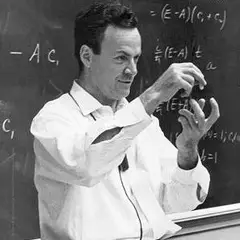
Richard Phillips Feynman
1918 – 1988- Books
- 18
- Followers
- 0
About
Richard Phillips Feynman was an American theoretical physicist known for his work in the path integral formulation of quantum mechanics, the theory of quantum electrodynamics, and the physics of the superfluidity of supercooled liquid helium, as well as in particle physics for which he proposed the parton model. For his contributions to the development of quantum electrodynamics, Feynman, jointly with Julian Schwinger and Sin-Itiro Tomonaga, received the Nobel Prize in Physics in 1965.
- Wikipedia
Top genres
Science Non-Fiction Essays Philosophy Biography
Also known as
Featured works
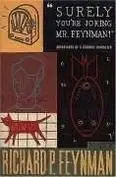
Start here3.8
Surely You're Joking, Mr. Feynman!
Ralph Leighton
Narrative non-fiction
Richard P. Feynman #1
4.0
What Do You Care What Other People Think?
Ralph Leighton
Narrative non-fiction
Richard P. Feynman #2
5.0
The Meaning of It All
Richard Phillips Feynman
Narrative non-fiction
3.0
Six Easy Pieces
Paul Davies
Essays
The Feynman Lectures on Physics #0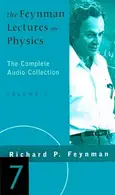
The Feynman Lectures on Physics, Vol. 1
Richard Phillips Feynman
The Feynman Lectures on Physics #1Series



Authors in the same genres


P

Frequently asked questions
Richard Feynman is widely recognized for his groundbreaking work in theoretical physics, particularly his contributions to quantum electrodynamics, for which he received the Nobel Prize. He is also celebrated for his engaging and accessible explanations of complex scientific concepts.
While there are no direct film or TV adaptations of his scientific papers, several documentaries and biographical films have explored Richard Feynman's life and ideas, often drawing from his popular writings and lectures.
For readers new to Richard Feynman, "Surely You're Joking, Mr. Feynman!" is an excellent entry point. It offers a collection of his humorous and insightful anecdotes, providing a glimpse into his personality and approach to life and science.
Richard Feynman's writing is characterized by its conversational tone, wit, and clarity, even when discussing complex scientific topics. He often incorporates personal anecdotes and a sense of playful curiosity, making his work engaging for a broad audience.